Safe Eval
Sooner or later an application wants to run code it did not write: a formula a user typed, a
pricing rule an administrator saved, a snippet a language model produced. JavaScript's eval and
new Function will run it, with the full authority of your program: it can read your variables,
call your servers, and loop until the page dies. So nobody sensible uses them for this.
Eval and SafeFunction run that code in a sandbox instead, and make three promises:
- It halts. Every step costs fuel, and a run that spends its budget is stopped. A wall-clock timeout backs that up.
- It reaches nothing you did not hand it. No network, no files, no host globals. The only way out is a capability you inject (or a fetch allowlist you set), and you decide what each one does.
- It holds copies, not references. What you pass in, and what your capabilities return, is copied as plain data. The code cannot touch a host object or change one you still hold.
The sandbox is the same fuel-metered VM that runs AJS agents, exposed as the two calls
JavaScript already has: eval() becomes Eval, new Function() becomes SafeFunction. The
code that calls it is not guaranteed to halt; the code inside it is.
Three words used throughout
- Fuel is the work budget. Each step the code takes costs a little: a short snippet like
a + bcosts well under 1, one iteration of awhileloop about 0.4, anhttpFetch5, and a model call 100.fueldefaults to 1000, which is roughly 2,500 loop iterations or ten model calls. To size it for your own code, run it on typical input and look atfuelUsed, then allow a few times that. - An atom is a built-in operation the code can call, such as
httpFetchorllmPredict. Atom calls look synchronous to the code: writelet data = httpFetch({ url }), with noawait(inEvalandSafeFunction,awaitis refused). Atoms take one object of named inputs. - A capability is a function you inject that an atom calls on the code's behalf. Without it the atom fails. The atom names and the capability keys differ:
| The code calls | Your capability | It receives |
|---|---|---|
httpFetch({ url, method, … }) |
capabilities.fetch(url, init) |
the URL, and the request (below) |
llmPredict({ prompt }) |
capabilities.llm.predict(prompt) |
the prompt string |
Eval — run code once
Eval runs a snippet in the sandbox and returns what it produced, with the fuel it used. The
code sees only the context you hand it, as variables.
import { Eval, SafeFunction } from 'tjs-lang/eval'

const { result, fuelUsed } = await Eval({ code: 'a + b', context: { a: 1, b: 2 } })
console.log(result) // → 3
console.log(fuelUsed > 0) // → true
The code is AJS: a JavaScript subset, so most expressions and statements read as
you expect, with AJS's rules. The ones a JavaScript author meets first: no for loops (use
while with a counter), no new, no class, no throw, arrow functions only as callback
arguments (items.filter(x => x > 1) works, a bare x => x does not), assignment only to a
plain variable (not obj.key = …), and operators that refuse to turn an array into a string.
One rule decides what Eval returns. If the code contains a return and is not a single
expression, it runs as a block of statements and gives back what it returns. Otherwise it is
read as one expression, and its value is the result. So a block of statements without a
return is read as an expression, fails to parse, and comes back as an error:
const summed = await Eval({
  code: 'let total = a + b\nreturn total * 2',
  context: { a: 1, b: 2 },
})
console.log(summed.result) // → 6

const forgot = await Eval({
  code: 'let total = a + b\ntotal * 2',
  context: { a: 1, b: 2 },
})
console.log(forgot.result) // → undefined
console.log(forgot.error.message) // → The keyword 'let' is reserved at <source>:2:0
The line number in that message is one past the line you wrote, because Eval wraps your code
in a function before parsing it. A block whose only return sits inside an if that is not
taken runs to the end and returns undefined, with no error.
The context is copied in, never shared. The code can change what it was given, but it is changing its own copy, so the value you passed is untouched:
const tags = ['sale']
const tagged = await Eval({
  code: "tags.push('clearance')\nreturn tags",
  context: { tags },
})
console.log(tagged.result) // → ["sale","clearance"]
console.log(tags) // → ["sale"]
Two details about context keys. A key never replaces a builtin: an entry called Math or NaN
is ignored. And only keys the code uses as names are copied in, so a large context costs only
what the code reads, and a string literal in the code can never pick up a context value by
having the same text. A let or const the code declares shadows a context key of the same
name.
SafeFunction — compile once, call many times
SafeFunction turns a function body into a callable. Its parameters are names, and each call
returns the same shape as Eval. SafeFunction itself is async, so await it to get the
function.
const add = await SafeFunction({ params: ['a', 'b'], body: 'return a + b' })
console.log((await add(1, 2)).result) // → 3
console.log((await add(20, 22)).result) // → 42
The source is transpiled once, when you create the function. The budget belongs to each
call, not to the function: every call starts with the full fuel it was given, so one call
that runs out does not starve the next.
const countTo = await SafeFunction({
  params: ['n'],
  body: 'let i = 0\nwhile (i < n) {\n  i = i + 1\n}\nreturn i',
  fuel: 50,
})
console.log((await countTo(5)).result) // → 5
console.log((await countTo(5000)).error.message) // → Out of Fuel
console.log((await countTo(5)).result) // → 5
A missing
returnbehaves differently in the two. The body of aSafeFunctionis a function body, so without areturnit givesundefinedand no error, as a JavaScript function would. The same code inEvalis a parse error. Code moved from one to the other can therefore fail silently. Ifundefinedis never a valid answer for your function, treaterror === undefined && result === undefinedas a failure.const double = await SafeFunction({ params: ['n'], body: 'n * 2' }) const doubled = await double(3) console.log(doubled.result, doubled.error) // → undefined undefined
Creating a SafeFunction can throw, unlike everything else on this page. A body that does
not parse, or is over the source size limit, makes SafeFunction(...) reject, before any of
the code has run. Once created, each call returns its errors as values, like Eval. So when the
body comes from someone else, wrap the creation in try.
That makes SafeFunction the right shape for logic someone else writes and you run many times,
such as a pricing rule an administrator typed into a settings page:
const ruleSource = 'if (qty >= 10) {\n  return price * qty * 0.9\n}\nreturn price * qty'

let priceRule
try {
  priceRule = await SafeFunction({ params: ['price', 'qty'], body: ruleSource, fuel: 100 })
} catch (e) {
  console.log('This rule has an error: ' + e.message) // show it to the rule's author
}
console.log((await priceRule(4, 10)).result) // → 36
console.log((await priceRule(4, 2)).result) // → 8
The rule is text you can store, version and show to the person who wrote it. It can compute, but it cannot read a file, call a server or loop forever.
Options and results
| Option | Eval |
SafeFunction |
Default | Meaning |
|---|---|---|---|---|
code |
yes | (required) | The snippet to run. | |
context |
yes | {} |
Values the code sees as variables, copied in. | |
body |
yes | (required) | The function body. | |
params |
yes | [] |
Parameter names; each call's arguments are copied in under these names. | |
fuel |
yes | yes (per call) | 1000 |
The work budget (see Three words). |
timeoutMs |
yes | yes (per call) | 4 minutes | Wall-clock limit (see Nothing runs forever). |
capabilities |
yes | yes | none | fetch, llm, and any others the code may use. |
fetchPolicy |
yes | yes | none | { domains, methods, headers } for httpFetch (see below). |
maxSourceBytes |
yes | yes | 8192 | Source size cap, checked before transpiling; 0 disables it. |
argsMaxBytes |
yes | yes | 4 MB | Cap on the context or call arguments copied in. |
Every run returns { result, fuelUsed, error }. When the run succeeds, error is undefined.
When it fails, error is { message }, a single string field.
Check error before you use result. After a failure result is not undefined: it can
be the VM's internal error object, whose cause carries a host stack trace with your file paths.
Never forward result to a client without checking error first.
Nothing runs forever
A run that spends its fuel is stopped, and the failure comes back as a value:
const runaway = await Eval({
  code: 'let i = 0\nwhile (true) { i = i + 1 }\nreturn i',
  fuel: 100,
})
console.log(runaway.error.message) // → Out of Fuel
Fuel is not the only stop. Waiting on IO burns no fuel, so a wall-clock timeoutMs ends a run
that is merely waiting, and cancels the request it was waiting on:
const slow = await Eval({
  code: "return httpFetch({ url: 'https://api.example.com/products' })",
  capabilities: {
    fetch: () => new Promise((resolve) => setTimeout(() => resolve([]), 500)),
  },
  timeoutMs: 50,
})
console.log(slow.error.message.startsWith('Execution timeout after 50ms')) // → true
The default timeout is 4 minutes: twice the 2-minute limit on a single model call. That
suits a background job. When a person is waiting on the answer, pass your own timeoutMs.
Memory is bounded separately from work. The code can hold at most 64 MB live at once; past that
the run fails with Heap limit exceeded: guest state holds ~96MB, limit 64MB…. Eval and
SafeFunction cannot change this limit; AgentVM's maxHeapBytes can.
Source is bounded before any of this starts. Transpiling happens before fuel and the timeout apply, so source over 8 KB is refused unread, as an error like any other:
const longText = `'${'a'.repeat(9000)}'.length`
const tooLong = await Eval({ code: longText })
console.log(tooLong.error.message.includes('over the 8192-byte limit')) // → true

const trusted = await Eval({ code: longText, maxSourceBytes: 16 * 1024 })
console.log(trusted.result) // → 9000
Raise maxSourceBytes only for source you trust, such as code from your own repository.
Errors are values
Every failure inside the sandbox comes back in error: running out of fuel or time, a missing
capability, a forbidden property, a bug in the code. A call to Eval, or to a SafeFunction
you have already created, never throws, and the code inside cannot make it throw.
const nosy = await Eval({ code: 'cfg.constructor', context: { cfg: {} } })
console.log(nosy.error.message) // → Security Error: Access to 'constructor' is forbidden

const noModel = await Eval({ code: "return llmPredict({ prompt: 'hi' })" })
console.log(noModel.error.message) // → Capability 'llm.predict' missing
The code can catch some failures with try/catch and fall back. Others end the run, even
inside a try, so that the code cannot loop on them:
| Failure | Caught by the code's try? |
|---|---|
| A capability throws (the network is down, a 500) | yes |
| A domain, method or header the fetch policy does not allow | yes |
| A missing capability | yes |
A forbidden property (constructor, __proto__) |
yes |
| The heap limit | yes |
| Out of fuel | no, the run ends |
| The timeout | no, the run ends |
| A capability returns something that is not plain data | no, the run ends |
The last row is the one to watch: a capability that throws is the world failing, and the code
may handle it; a capability that returns a Response or a class instance is a bug in your host
code, and the run stops (see below).
const offline = await Eval({
  code: "try {\n  return httpFetch({ url: 'https://api.example.com/products' })\n} catch (e) {\n  return 'fallback: ' + e\n}",
  capabilities: {
    fetch: async () => {
      throw new Error('network down')
    },
  },
})
console.log(offline.result) // → fallback: network down
In the catch, e is the error's message, a string, not an Error. This differs from
JavaScript: e.message is undefined. Use e itself.
Nothing reaches out unless you allow it
The sandbox has no network, no file system and no host globals. What it does have is a small
set of builtins: Math, JSON, and the usual methods on strings, arrays and objects. console
calls are accepted, but their output goes to the VM's trace, which Eval and SafeFunction do
not return; to see a value, return it. There is no atom for reading files at all.
There are two ways to grant network access, and the code uses httpFetch in both:
- Inject a
fetchcapability. The code gets your function, with whatever rules you put in it. - Set
fetchPolicy.domainswith nofetchcapability. That turns on the VM's built-in fetch, for those domains only. It calls the host'sfetch, follows no redirects (a redirect comes back to the code as data), and sends no cookies or HTTP auth. The allowlist is the whole destination check, so list only public hosts: a private or loopback address you list (127.0.0.1, say) is fetched.
With neither, httpFetch fails: Fetch blocked: no allowedFetchDomains configured….
What your fetch capability receives and returns
Before your function is called, the VM admits the request's shape: http: or https: only,
GET and HEAD unless the policy allows more, and only these request headers: accept,
accept-language, authorization, cache-control, content-language, content-type,
if-match, if-modified-since, if-none-match, if-unmodified-since, range, user-agent,
x-api-key, x-request-id, x-correlation-id and x-requested-with. The list is closed
because every proxy invents another routing header, and a header the code may set is one it can
use to redirect a request.
Your function is then called as fetch(url, init), where init is
{ method, headers, body, signal }. The code chose method, headers and body; body is the
code's value as data, so JSON.stringify it yourself. Pass signal on, so a timed-out run
cancels the request. headers also carries an X-Agent-Depth header (see the
known gap).
Your function owns everything the VM cannot judge:
- The destination. Check the hostname, or set
fetchPolicy.domains. - Redirects. Do not follow them (
redirect: 'error'): a redirect can send an allowed request on to a host you never allowed, such as an internal address. - Credentials. Send none (
credentials: 'omit'): otherwise, in a browser, the code's requests carry the user's cookies.
Return the response body as plain data, never the Response itself. If the code needs the
status, return { ok, status, body }, built field by field.
In the example below, upstream stands in for the real fetch so that it runs anywhere; it
answers with two products, a widget at 40 and a gadget at 250.
// Stand-in for `fetch`. In your app, call fetch(url, options) here.
const upstream = async (url, options) =>
  new Response(JSON.stringify([{ name: 'widget', price: 40 }, { name: 'gadget', price: 250 }]))

const allowed = ['api.example.com']
const safeFetch = async (url, init) => {
  const { protocol, hostname } = new URL(url)
  if (protocol !== 'https:' || !allowed.includes(hostname)) {
    throw new Error(`Domain not allowed: ${hostname}`)
  }
  const { 'X-Agent-Depth': _depth, ...headers } = init.headers // not an agent endpoint
  const res = await upstream(url, {
    method: init.method,
    headers,
    body: init.body === undefined ? undefined : JSON.stringify(init.body),
    signal: init.signal,
    redirect: 'error',
    credentials: 'omit',
  })
  return res.json() // the BODY, not the Response
}

const cheap = await Eval({
  code: `
    let products = httpFetch({ url: 'https://api.example.com/products' })
    return products.filter(x => x.price < budget)
  `,
  context: { budget: 100 },
  capabilities: { fetch: safeFetch },
})
console.log(JSON.stringify(cheap.result)) // → [{"name":"widget","price":40}]

const blocked = await Eval({
  code: "return httpFetch({ url: 'https://evil.example.net/steal' })",
  capabilities: { fetch: safeFetch },
})
console.log(blocked.error.message) // → Domain not allowed: evil.example.net
Stating the policy as data
fetchPolicy states the rules as data, and the VM enforces them before your fetch is called.
domains is an allowlist; methods and headers add to the defaults above, for example
fetchPolicy: { methods: ['POST'], headers: ['x-tenant'] }. The code never sees the policy.
Use fetchPolicy for declarative allowlists, and your own wrapper for anything else (rate
limits, logging, rewriting). Using both is defence in depth.
const neverCalled = async () => [] // the VM refuses both requests before this runs

const policed = await Eval({
  code: "return httpFetch({ url: 'https://other.example.org/data' })",
  capabilities: { fetch: neverCalled },
  fetchPolicy: { domains: ['api.example.com'] },
})
console.log(policed.error.message) // → Fetch blocked: domain not in allowlist. Allowed: api.example.com

const posting = await Eval({
  code: "return httpFetch({ url: 'https://api.example.com/products', method: 'POST', body: { name: 'x' } })",
  capabilities: { fetch: neverCalled },
})
console.log(posting.error.message.includes("method 'POST' is not allowed")) // → true
A capability that returns a Response ends the run
A capability is your code, and the boundary holds it to the same rule as the guest: what
crosses is plain data. A capability that returns something JSON cannot express, here the
Response itself, is a bug in the host. It ends the run even inside the code's try, so the
code cannot keep retrying it:
const leaky = await Eval({
  code: "try {\n  let r = httpFetch({ url: 'https://api.example.com/products' })\n  return 'got it'\n} catch (e) {\n  return 'caught'\n}",
  capabilities: { fetch: async () => new Response('[]') }, // returns the Response: a host bug
})
const refusal = "Capability boundary rejected the return of 'httpFetch': capability return contains an instance of Response"
console.log(leaky.error.message.startsWith(refusal)) // → true
Neither 'got it' nor 'caught' comes back: the run stopped at the httpFetch.
Host objects stay outside
Context values cross the same boundary. Plain data (objects, arrays, strings, numbers, booleans,
null, and Date) is copied in. A class instance is refused rather than thinned, because its
getters and private fields would silently read as undefined on the other side:
class Account {
  constructor(balance) {
    this.balance = balance
  }
}
const live = await Eval({ code: 'account.balance', context: { account: new Account(10) } })
console.log(live.error.message.includes('instance of Account')) // → true

const copied = await Eval({ code: 'account.balance', context: { account: { balance: 10 } } })
console.log(copied.result) // → 10
Pass the fields the code needs, by name. The same goes for what a capability returns. Do not
spread a host object to "make it plain": a Response keeps ok, status and headers on its
prototype, not on itself, so { ...res } is {}. It crosses the boundary cleanly and delivers
nothing. Build the object field by field:
const withStatus = async (url, init) => {
  const res = new Response('{"error":"no such product"}', { status: 404 }) // stand-in for fetch
  return { ok: res.ok, status: res.status, body: await res.json() }
}
console.log({ ...new Response('') }) // → {}

const lookup = await Eval({
  code: "let r = httpFetch({ url: 'https://api.example.com/products/9' })\nif (!r.ok) {\n  return 'HTTP ' + r.status\n}\nreturn r.body",
  capabilities: { fetch: withStatus },
})
console.log(lookup.result) // → HTTP 404
A model is a capability too
llmPredict({ prompt }) calls the llm.predict(prompt) function you inject, with the prompt
string, and hands the code whatever plain data you return. The code can use a model without
knowing which one, where it runs, or what key it uses:
const answered = await Eval({
  code: "return llmPredict({ prompt: 'Summarize: ' + text })",
  context: { text: 'Fuel bounds work.' },
  capabilities: {
    llm: { predict: async (prompt) => `(a summary of ${prompt.length} characters)` },
  },
})
console.log(answered.result) // → (a summary of 28 characters)
console.log(answered.fuelUsed >= 100) // → true
A model call costs 100 fuel, whatever it costs you. Fuel limits how many calls fit in a run only
indirectly. To cap the number of model calls directly, use AgentVM with
quotas: { llmPredict: 3 } (next section).
When to reach for AgentVM instead
Eval and SafeFunction are the two-line entry points: source in, { result, fuelUsed, error }
out. Use AgentVM directly (see the AJS guide) when you need more:
- Per-atom call quotas (
quotas: { llmPredict: 3 }), and a memory ceiling of your choosing (maxHeapBytes). - Separate compile and run. Transpile on a trusted machine (or the client's), store the JSON
AST, and run it later with
tjs-lang/vm-ast, a VM with no parser in it. A sandbox that cannot parse has no parser bug to reach. - Tracing (
trace: true), to see every step and what it cost, includingconsoleoutput. - Your own atoms: operations you define, registered with the VM and checked by the transpiler.
- Agent depth for an endpoint that other agents call (see the known gap).
Here an agent is allowed three model calls and asked for four:
import { transpile } from 'tjs-lang/lang'
import { AgentVM } from 'tjs-lang/vm-ast'

const { ast } = transpile(`
function summarize({ texts: ['a'] }) {
  let out = []
  let i = 0
  while (i < texts.length) {
    let summary = llmPredict({ prompt: 'Summarize: ' + texts[i] })
    out.push(summary)
    i = i + 1
  }
  return { out }
}`)

const vm = new AgentVM()
const run = await vm.run(ast, { texts: ['a', 'b', 'c', 'd'] }, {
  fuel: 1000,
  timeoutMs: 10_000,
  quotas: { llmPredict: 3 },
  capabilities: { llm: { predict: async (prompt) => prompt.toUpperCase() } },
})
console.log(run.error.message) // → Quota exceeded for 'llmPredict': 3 calls allowed
What the sandbox guarantees, and what it does not
Here is exactly what is promised, with where on this page each promise is shown running.
- Termination is guaranteed, not decided. Fuel sidesteps the halting problem rather than solving it: every step costs fuel, so a program either finishes or is stopped. A wall-clock timeout covers code that is waiting rather than working, and a stopped run cancels any request it had in flight. (Nothing runs forever.)
- Bounded memory. The code can hold at most 64 MB live at once, separately from fuel, which bounds only how much work it does.
- Bounded input. Source over 8 KB is refused before it is transpiled, because transpiling
runs before fuel and the timeout apply. Context and arguments are capped at 4 MB. Serving
untrusted callers? Have them send an AST, transpiled on their side, and run it with
tjs-lang/vm-ast, which contains no parser. - No ambient authority, that is, no power the code has merely by running: it gets no IO
unless you grant it, through a capability or a
fetchPolicy.domainsallowlist. Every atom that touches the outside world is tagged as IO, and the tagging is itself tested, so the ways out can be listed. (Nothing reaches out.) - The code holds data, not references. Context values going in, and capability returns
coming back, are rebuilt as fresh copies of JSON data plus
Date. Anything else (aResponse, a function, an object with getters, aMap, a typed array, a class instance) is refused rather than passed through. (Host objects stay outside.) - Tested, not formally proven. These properties are enforced by the VM's design and covered by an adversarial test suite (hostile programs, a seeded random-program fuzzer, probes of every method the code may call). A formal specification is proposed but does not exist yet.
- Known gap: agents calling agents. Fuel bounds the current run, not the services it calls,
so an agent that fetches another agent's endpoint can fan out. Every
httpFetchcarries anX-Agent-Depthheader, and the VM refuses to fetch once the incoming depth reaches 10. The VM's built-in fetch sends the header only to the page's own origin in a browser, since a custom header turns every cross-origin request into a CORS preflight. Afetchcapability always receives it ininit.headers, whatever the destination, and decides itself whether to forward it (thesafeFetchabove drops it). The check is cooperative: it works only if the receiving endpoint passes the header on, which needsAgentVM;EvalandSafeFunctionalways start at depth zero. It stops accidental loops, not a hostile endpoint, so rate-limit open endpoints. - Out of scope: timing side channels, JavaScript-engine JIT bugs and memory-level attacks. A JavaScript-in-JavaScript sandbox cannot address those; put process isolation underneath if your threat model includes them.
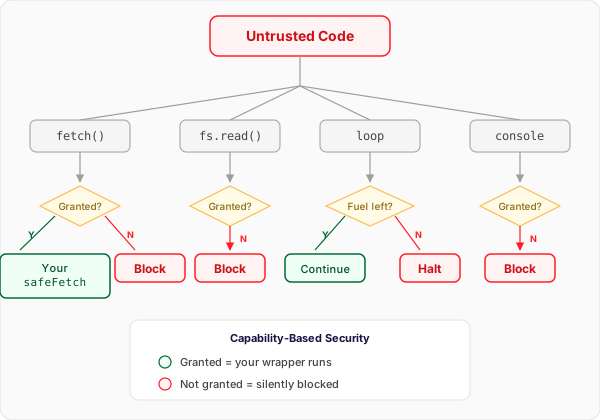
The picture
Untrusted code reaches the world only through a capability you granted. Each request is
checked; a granted one runs your wrapper (such as safeFetch), and a loop runs only while fuel
lasts.